Tuesday, November 30, 2010

Where's The Redistricting?

 In his book Critical Elections and Congressional Policy Making, David W. Brady defines a critical election as one in which one political party takes control of the House, Senate and Presidency for at least a decade. No election after the New Deal era meets these criteria. I believe that his definition is too strict and therefore fails to consider several elections that have had a great deal of impact on public policy.

After critical elections, the House of Representatives has created major policy changes, such as ending slavery or creating Social Security. Baker's own introduction credits the 1965 Congress for the major civil rights legislation it passed, yet in his conclusion he states that neither 1964 nor 1968 were critical elections. However, there was a dramatic shift in each party's stance on civil rights during this time period, accompanied by regions of the country shifting loyalties: the Democratic states in the South began to vote Republican, and Republican strongholds in the North began to vote Democratic. These opposing movements prevented either party from making large gains in the House or the Senate, but it was still an era of great change, much like earlier critical elections.

Baker's book was published in 1988, but if he had waited until after the 1994 election, he would not have included it as a critical election. President Clinton was reelected in 1996, an immediate disqualification in Baker's book. However, there was a 54-seat swing to the Republicans in the House and an 8-seat swing in the Senate. This also brought on great political polarization, culminating in government shutdowns, similar to the polarization noted by Baker after earlier critical elections.

In 2008, Democrats did take back the Presidency in another possible critical election, but they didn't hit the decade mark: Republicans took back the House two weeks ago after just 4 years of a Democratic majority. However, the health care reform bill was passed after this election, a major public policy shift similar to those seen after the elections of 1932 and 1964.

Friday, November 5, 2010

Mr. Wilson Goes (Back) To Washington

Congratulations to Representative Joe Wilson, who won reelection Tuesday night in South Carolina's 2nd Congressional district with 138,755 votes, compared to 113,354 votes for his Democratic opponent Rob Miller. Miller had a strong campaign, but in the end, toppling a Republican incumbent in a poor year for Democrats was too tall a task.

Representative Wilson will be joining a different House of Representatives on January 6th. His party will now be in the majority, and Wilson's favorite bogeyman during this campaign, Nancy Pelosi, will no longer be the Speaker of the House. Instead, it appears that John Boehner of Ohio, the current Minority Leader, will be the Speaker of the House. As the majority party controls what legislation is brought to the floor for debate, Representative Wilson will now have a better opportunity to bring up laws he would like to see passed. It will be interesting to see if he does propose legislation that would cut spending and eliminate all or part of the recently passed health care reform law, as he promised during his campaign. It will also be interesting to see how Wilson runs his campaign in 2012, since his party will bear more responsibility for what happens in Washington, D.C.

I would also like to point out something about the results: Wilson garnered 53% of the vote, compared to Miller's 44%, a 9-point difference. That is certainly a respectable result for Representative Wilson, and it is a slight improvement on his margin of victory in 2008, when he defeated Mr. Miller by 8 points. (Interestingly, Representative Wilson actually got less of the vote this year. He won 54% in 2008 to Miller's 46%, but there were no minor party candidates in 2008. In 2010, Libertarian Eddie McCain and Marc Beaman of the Constitution Party each got a small percentage of the votes.)

In my last blog post before the election, I noted that FiveThirtyEight's model predicted a 21-point win for Wilson, and I disagreed with this, saying that the 7-point margin predicted in an October poll was much more likely to be accurate. I know it's mostly political science majors reading this blog, not math majors, but I think even we can figure out that 9 is much closer to 7 than 21.

So does this mean I'm smarter than Nate Silver? Probably not, but a girl can dream.

Thursday, October 28, 2010

In Which I Take On Nate Silver's Projections


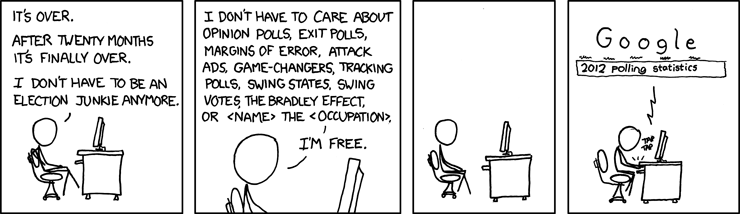
The comic above was published by XKCD the day after the 2008 elections, and when users hovered their mouse over the comic, a text window read "Someday I'll be rich enough to hire Nate Silver to make all my life decisions. 'Should I sleep with her?' 'Well, I'm showing a 35% chance it will end badly.'"

Nate Silver is referenced in webcomics because he developed models to predict the 2008 Presidental and Senate elections for his blog FiveThirtyEight. This year, he has expanded his forecasts to include House and gubernatorial elections. I have a tremendous amount of respect for his site and find it slightly more addictive than crystal meth. However, I have to disagree with his projection for SC-02. Silver's model projects that Joe Wilson will win 59.2% of the vote and Rob Miller will get 38.0%, and that Wilson has a 99.4% chance of winning. Now, Representative Wilson is an incumbent Republican, in a good year for Republicans and a strongly Republican district, so I do think Wilson is the favorite, but I think that the margin of victory in the end will be much closer than 21 points.

Simply put, Nate Silver's model doesn't know that Joe Wilson is the "you lie!" guy. Incumbent politicians who are embroiled in scandals tend to struggle in their reelection bids. In September 2009, Wilson yelled "you lie!" at President Obama during his speech to Congress on health care, sparking national outrage. In addition, the House ethics committee is investigating Wilson's use of travel funds on Congressional trips to Afghanistan, and Miller has criticized Wilson sharply for this in advertisements.

Joe Wilson certainly has raised an impressive amount of money: $4.5 million, to be exact. However, Rob Miller has raised $2.8 million, and the combined fundraising total of $7.3 million makes this race the most expensive U.S. House race in the country. Despite Wilson's fundraising prowess, an expensive race isn't good for an incumbent. It's an indicator that the incumbent is vulnerable and both parties are prepared to fight it out over the seat. I think we can take the sky-high fundraising totals as a sure sign that this race will be a close one.

Finally, the prediction of a 21-point win just doesn't match the polling or the history of this district. A poll in early October put Wilson ahead of Miller by just 7 points, and no other poll has been published since early May. This race is a rematch of 2008, in which a non-scandal-ridden Wilson beat Miller 54-46. Now, one could argue that 2010 will likely be a much better year for Republicans than 2008 was, and I agree in general. However, I don't think that the shift in the nation's mood is strong enough to cause a 13-point swing in this race, especially given Joe Wilson's shenanigans since November 2008. I think the poll showing a 7-point Wilson victory is much more likely to be accurate than Nate Silver's projection of a 21-point Wilson victory, and it might even be closer than that poll shows.

Friday, October 22, 2010

Is Miller the Comeback Kid?

A recent poll commissioned by Democrat Rob Miller's campaign showed him trailing Republican Representative Joe Wilson in the SC-02 race by 7 points on October 15th. Previous polls had showed Wilson beating Miller by 15 points in May and 10 in September, indicating that Miller may be closing the gap. Of course, Miller is still losing, three polls is a small sample size, and as New York Times' statistical guru Nate Silver reminds us, momentum doesn't necessarily mean much, the polls could stop moving or swing in the other direction at any time. Still, I think that Miller is climbing in the polls because he is running a strong campaign and attacking Wilson in three key areas that give him the best possible advantage in this election. Let's take a look at those areas.


The $100,000 referenced in this ad for "vacations" is part of a controversial issue for Rep. Wilson that is described in greater detail here. In short, Wilson claims that each visit was to "support the troops," while Miller says this is not true and the trips represent wasteful spending. This and the other claims in the ad create a massive headache for Wilson in an election season where many voters are concerned about excessive government spending.

In addition, in the article linked above, Miller states that in his experience as a combat veteran, visits from politicians require large amounts of extra security, and the benefits to the troops are outweighed by the additional costs. This critique reminds voters that Rob Miller's military experience vastly outweighs Joe Wilson's. In this heavily militarized district, that could make a difference. To bring the point home, Rob Miller is also attacking Joe Wilson for his D rating from Iraq and Afghanistan Veterans of America, a nonpartisan group that advocates for policies to improve the lives of veterans of the wars in Iraq and Afghanistan.

I previously discussed one of Rob Miller's other ads in this entry. The main point behind that ad was that Joe Wilson was voting for policies that supported big business and himself, while taking jobs away from the average worker, and the ad played off Wilson's slogan "Joe Means Jobs." As I said before, I think this ad was very effective, especially since the unemployment rate remains high.

Many voters don't like negative advertising and attacks on political opponents, but Rob Miller seems to be using them very effectively in his campaign for Congress. Surprisingly, these attacks don't generally include the infamous "You lie!" incident, although it's apparent Miller supporters haven't forgotten about it. Take a gander at this cleverly titled article about Wilson's trips to the troops: Dodging Mortars? You Lie!

Saturday, October 16, 2010

Don't be A One-Man Wolf-PAC

Due to some campaign laws that should probably be revisited, individuals can only donate $2,400 to a candidate, while political action committees, or PACs, can contribute up to $5,000 per candidate. Therefore, candidates for office court PACs as well as individuals to fund their campaigns. Upon first glance, Republican Representative Joe Wilson appears to be doing a far better job than Rob Miller, the Democratic candidate, at collecting donations from PACs.  Wilson has collected $383, 608 from 264 PACs to date, according to statistics from OpenSecrets, while Miller has just $145,502 from 71 PACs. However, a closer look at the data reveals that Rob Miller is doing just as well or even better than Joe Wilson in fundraising from some important types of PACs, and his financial disadvantage stems from a massive disparity in donations from business-related PACs.

Leadership PACs are formed by politicians, usually incumbents in safe reelection campaigns, to support other politicians. Candidate campaign committees are not legally considered PACs, but may donate up to $2,000 per election to another candidate's campaign committee. One would think that because of Representative Wilson's connections as a current member of Congress, he would do quite well in this category., and he has raised $32,182 from leadership PACs and $15,000 from campaign committees. However, Rob Miller is keeping pace with the Congressman. He has collected $26,500 from leadership PACs, and $19,250 from campaign committees, besting Wilson in the latter category and coming close in the former.

Despite his financial disadvantage,  Rob Miller has something to brag about in the PAC fundraising numbers: money from labor PACs. Joe Wilson has raised a paltry $6,000 from PACs tied to labor unions, while Rob Miller has collected a whopping $82,500 from these PACs. Labor unions tend to favor Democratic politicians, while businesses tend to prefer Republicans, and that leads us to our final category...

Business PACs and Joe Wilson are totally BFFs. Wilson has promised lower taxes and business-friendly policies, and business PACs have rewarded him with $309,299 in donations, while Rob Miller has gotten just $11,000 from this sector. No matter how much money Rob Miller gets from other important groups or individuals, it's tough to come back from a fundraising disparity that large.

If Rob Miller wanted to turn lemons into lemonade, he could claim that labor unions' support of him, along with "big business" supporting his opponent, is a sign that he is the better candidate for the average South Carolina voter, while Wilson will vote to benefit big business.

Thursday, October 7, 2010

My Opponent Will Take Away Your Job. And Kick Puppies. Maybe.

 Ah, fall. The air is getting cooler, the leaves are changing color, the kids are picking out their Halloween costumes, and the politicians are slinging mud at each other. Wait, what? It may not be anyone's favorite part of campaign season, but attack ads have been part of the political landscape since modern democracy came to be. Many politicians use attack ads in attempts to define their opponent and highlight issues with their qualifications, ethics or character. Some voters may be turned off by negative ads and disengage from the election, and in some instances, backlash from an attack ad has hurt the campaign that released it. However, negative advertisements can also attract the most attention to the election and energize the electorate. Representative Joe Wilson and Rob Miller's campaigns both released negative advertisements within the past two weeks, and today I would like to look at those ads to see what kind of messages they want us to hear about each other.


This is the ad Rob Miller's campaign released two weeks ago, called “Says.” The ad plays off Wilson's campaign slogan “Joe Means Jobs,” pointing out ways in which Joe Wilson has voted to benefit himself and big business while taking jobs away from the district.


This is the ad released by Joe Wilson's campaign on Monday, titled "Rob Miller Job Killer." It links Rob Miller to the “job killing” policies of Nancy Pelosi and Barack Obama, including the health care reform bill, and makes use of the fact that “Rob Miller” rhymes with “job killer.”

In my opinion, Rob Miller has the more effective ad. I particularly like that he used Representative Wilson's own slogan against him. Since so much of Wilson's campaign has focused on how his policies will create jobs, the ad is quite effective at undermining his credibility. Wilson's ad may also be effective, especially in this conservative district, because it links Miller to some unpopular politicians and policies. However, I find the rhyming technique childish and distasteful. Who cares what Rob Miller's name rhymes with? It reminds me of Rush Limbaugh insulting then-Senator Barack Obama by referring to him as “Osama Obama” and “Obama Osama.”

Friday, October 1, 2010

Who's Making Bank In SC-02?

When incumbents raise money to run for reelection, they will often turn to individuals outside of their own district, while challengers will tend to focus on local fundraising. I thought it would be interesting to see how much money Joe Wilson and Rob Miller have raised in their home district, since donating even a small amount of money to a political campaign is a strong display of support for that candidate. The Huffington Post has an excellent tool that allows anyone to search for donations to candidates or party organizations by the zip code, town or name of the donor: Fundrace. I decided it would be interesting to pick a few towns in the district at random and see what the numbers said.


Hilton Head Island is a resort town on South Carolina's coastline with a year-round population of about 33,000. Joe Wilson was the clear winner in this town, receiving 47 individual donations totaling $26,126. Rob Miller only pulled in $14,450 from 27 donations.


Barnwell is a heavily African-American city of about 5,000 people near the Georgia border, about 75 miles northwest of the coast. Rob Miller is much more popular here, receiving 10 donations adding up to $7,350, while Joe Wilson got a mere $750 from 3 donors.


Hmmm...maybe the wrong Gaston is in the picture? Gaston, South Carolina, is a suburb of the state capital of Columbia, with a population of about 1,300 and a name that does not lend itself to accurate Google Image searches. Since it's so small, there's not much fundraising data to look at here, just one donation of $500 to Joe Wilson and none at all for Rob Miller.

I'm not sure how much I can really learn by picking only a few towns to study. I did try to pick places that varied in size and location within the district, but I don't know how representative these towns are of the district as a whole. However, it appears to me that Joe Wilson has a significant fundraising advantage within the district, and Rob Miller may have a difficult road ahead of him.

Sunday, September 26, 2010

Facebook Stalking the Candidates

I'll be honest: I didn't want to write a blog entry this week, I just wanted to waste my time on Facebook. However, both Representative Joe Wilson and Rob Miller have Facebook fan pages, so I decided to turn my procrastination into productivity and check out what kind of messages each candidate was sending to his fans. Wilson's Facebook page can be found here, and Miller's page is here.

As a side note, Wilson has 22,729 fans, while Miller has 5,510. One would think that such a large discrepancy in fans wouldn't bode well for Miller in the general election. However, two things should be noted: people in any part of the world can become “fans” of either candidate, and I have yet to see a study showing a correlation between a candidate's election results and the number of Facebook fans he or she has.


Miller tends to keep his Facebook status updates light, with many announcements about upcoming campaign events and photographs from previous ones, such as the picture above of him marching in a parade in Irmo, SC. If I were a voter in his district, I would be pleased that I was being offered so many opportunities to meet with Miller and get involved in the campaign, but I would be frustrated at the lack of depth and policy detail I found on his page.


The image above is the default image on Joe Wilson's Facebook fan page, and the rest of his page is similar in tone. Wilson posts many status updates and links with negative commentary about his political opponents, especially President Barack Obama and Speaker Nancy Pelosi. He even posted a video of himself speaking at a Fire Pelosi rally at the University of South Carolina. This harshly negative strategy could be very effective at getting his supporters motivated to vote and support his campaign. However, I could also see him alienating moderate voters who may support some of Obama and Pelosi's policy goals.

I think Wilson has the more effective page. It is clearly targeted at his most fervent conservative supporters, and I think it will tap into the anger many of them currently feel. I do not see anything on Miller's page that would similarly inspire liberals.

Friday, September 17, 2010

Military Man

In 2006, 27% of the members of the House of Representatives had previously been lawyers, 25% had been in public service and 22% had been in the business field. Rob Miller, the Democratic challenger to Republican Representative Joe Wilson in South Carolina's 2nd district, comes from a slightly different career path. His previous career was in the military, which produces only 9% of our Representatives. Miller's military career could potentially set him apart and give him a greater chance of winning his election than the average Democratic politician in this district.

Many Representatives have previously served in the military, but very few have done so for much of their career. Rob Miller served in the Marine Corps for 13 years, enlisting during his freshman year of college in 1995. He served two tours in Iraq and reached the rank of captain. Upon retiring from the Marine Corps in 2008, he and his wife opened up a store selling Marine Corps merchandise. Miller is a young politician and all of his professional experience is related to the military in some way.

The conventional wisdom for this year is that America is in an anti-establishment, anti-incumbent mood. Facing an incumbent is always a tall order, but it may be easier this year. If it is, Rob Miller may benefit from the perception that he is not a part of the political establishment, since his career path to date is rather unconventional for politicians. However, he was the Democratic nominee for this House seat in 2008 and lost by 8 points. Some voters may see him as part of the Democratic establishment because of this, which would harm his chances of victory.

SC-02 is also a district with a strong military presence. Parris Island, Fort Jackson and a Marine Corps air station are all located in the district. Voters may feel that they can relate to Miller's military background and be more inclined to vote for him. However, this may be tempered somewhat by the tendency of military members and veterans to vote Republican.

I think that Rob Miller's unconventional background will help him in a district so closely tied to the military. It remains to be seen if this will be enough for him to defeat Joe Wilson this time.

Friday, September 10, 2010

Week 1

South Carolina's second Congressional district is currently represented by Republican Joe Wilson. Joe Wilson is best known for a minor scandal that took place during President Barack Obama's speech to Congress about the health care bill in 2009. When the President stated that the bill would not provide health insurance for illegal immigrants, Representative Wilson shouted “You lie!” Liberals claimed that Wilson's remarks showed a lack of respect for the President, while some conservatives claimed that Wilson was brave for speaking his mind. A flurry of donations from across the nation poured in immediately after the speech for both Joe Wilson and his Democratic opponent, Rob Miller, a retired Marine who served in Iraq and is currently a small business owner. This is the race I have chosen to cover until the election.

This election will probably be quite competitive. When Rob Miller ran against Joe Wilson in 2008, Wilson garnered 54% of the vote to Miller's 46%. Both candidates have about 1.7 million dollars as cash on hand for their campaigns. The Democratic Congressional Campaign Committee has identified this race as one of its 25 “Red To Blue” races for 2010, and will lend additional financial and volunteer support to Rob Miller's campaign.

Chapter 1 of Paul S. Herrnson's book Congressional Elections claims that congressional elections in the U.S. are generally focused on candidates, not political parties. However, this year, the media narrative has been focused on electoral difficulties for the Democratic Party. I am curious about whether this election will focus on the individual candidates, and particularly Wilson's gaffe, or on the national stances and actions of the two major parties, and what the effects of that focus would be on each candidate.

I would also like to examine how the national attention Joe Wilson has received will affect this race. I am curious about how voters in heavily Republican SC-02 view Wilson: is he a source of pride or embarrassment to them? Will they still want to support him in this election? This is the main question I would like to find an answer to between now and the election on November 2nd.